

Food was an important part of court life at the Tudor palaces
What did the Tudors eat?
For the Tudors, food and meals were not just about eating. They were a display of the monarch’s power. Exotic foods demonstrated wealth, while seating arrangements reflected the court’s hierarchy.
Courtiers were served a menu of dishes containing around 5,000 calories a day.
Who could eat meat in the Tudor era?
By Henry VIII’s reign, the price of fresh meat had fallen sufficiently. When it was available, the average Tudor family could afford it.
The century before, poorer families would have rarely enjoyed meat, eating a diet of stewed vegetables and pulses. But the norm for 'average' people in the Tudor period was stored or preserved meat – regular fresh meat was the luxury of the court.
Tudor courtiers enjoyed a much wider variety of food, with freshly, slaughtered, roasted meat every day and the luxury of being able to choose from a 'menu' of dishes.
One surviving reference for the quantities of meat procured for the royal court in one year during Elizabeth I's reign included:
- 8,200 sheep
- 2,330 deer
- 1,870 pigs
- 1,240 oxen
- 760 calves
- 53 wild boar
These unusually high quantities, compared to previous years, may reflect a ‘restocking’ year in which meat not typically recorded was included in the accounts.
Masthead image: Detail of William Brooke, 10th Lord of Cobham, and His Family © The Pictures Now Image Collection / Mary Evans Picture Library
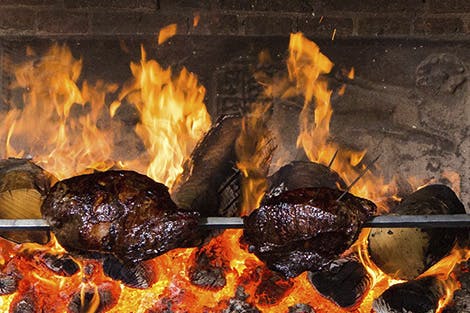
Image: Meat on the spit at Hampton Court, a popular Tudor cooking method. © Historic Royal Palaces
And if they [the nobles and many of their servants] do not have 20 varied meat dishes at dinner and supper, they consider themselves slighted.
Thomas Starkey, Oxford lecturer, c1529
Did the Tudors have a healthy diet?
During the Tudor period, it was thought that eating raw salads and fruits could cause sickness. This concern was rooted in the belief that eating certain foods could unbalance the body's natural state.
This was reinforced by the supply chain in which produce harvested when ripe often arrived to towns and cities past its best.
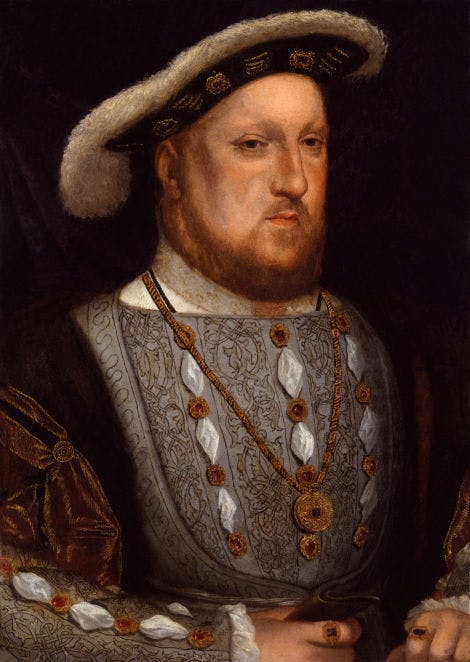
Image: Portrait of Henry VIII. @ National Portrait Gallery
What did Henry VIII eat?
As a Tudor King, Henry VIII ate whatever took his fancy from a huge buffet. Dishes included game, roasted or served in pies, lamb, venison and swan. During banquets, he might be served more unusual items such as conger eel and porpoise. Sweet dishes were often served along with savoury.
The King's meals were prepared in a private kitchen under the direction of the Privy (Private) Master Cook, John Bricket. Usually, the King ate in his private rooms, away from the crowds. On more formal occasions he sat alone at a high-covered table in his Presence Chamber, under the canopy of state.
A royal menu
The ‘Diett for the King’s Majesty and the Queen’s Grace’ for 'Dynner' included:
- First Course: Cheat Bread and Manchett, Beare and Ale Wyne, Flesh for Pottage (thick broth), Chines of Beef, Venison in Brew’z or mult’, Pestells of Reed Deere, Carpes of Young Veale in Arm’ farced, Custard garnished, or Fritters
- Second Course: Jelly, Ipocras, Creames of Almonds, Pheasant, Hern, Bitterne, Shovelard, Cocks, Plovers or Gulles, Larkes or Rabbits, Venison in fine past, Tarts, Fritter

Image: Carving knifes from the early 1400s. Knives in this style continued to be used for ceremonially carving meat throughout the medieval and Tudor periods. © The Trustees of the British Museum. Shared under a Creative Commons Attribution-NonCommercial-ShareAlike 4.0 International (CC BY-NC-SA 4.0) licence.
Did Henry VIII use cutlery?
The King was the only person at court to be given a fork, with which he ate sweet, sticky preserves.
Tudor people ate with knives, spoons, their fingers and small pieces of bread used much like flatbread today. Most people carried and used their own knives for meals, but spoons were usually provided when dining at court.
Forks were used for cooking, carving and serving food, but rarely for dining. The utensil did not become commonplace at mealtimes until centuries later.

Image: A member of the Historic Kitchens team creating Tudor sugar sculptures, also known as subtleties. © Historic Royal Palaces.
Food and wealth
In Tudor times using ingredients from distant countries was considered a sign of status. The variety of food available at court was staggering. Royal diners ate citrus fruit, almonds and olive oil from the Mediterranean.
Food was sweetened with sugar from Cyprus and seasoned with spices from China, Africa and India.
At special events, decorative sugar sculptures known as subtleties were brought out between courses, to be eaten or admired by guests, while the next course was prepared in the kitchen. Henry VIII, like many Tudor monarchs, used these extravagant displays of food at court as a powerful statement of his wealth and status.
Sit not down until you have washed. Don't shift your buttocks left and right as if to let off some blast. Sit neatly and still.
Dutch writer Erasmus' list of instructions for dining at court
The rules of eating at court
Around 400 courtiers and staff were entitled to two meals a day, served at 10am and 4pm. A strict set of rules, drawn up by the Lord Chamberlain, dictated where diners sat and what they were entitled to eat. Higher-ranking courtiers ate in the Great Watching Chamber, lesser ranks in the Great Hall.
The Clerks of the Kitchens, standing at the Serving Place, would allocate dishes to various diners according to their rank.
During mealtimes, senior officials ensured that every member of palace staff who was meant to be on duty was present and at work for the day.
Take a look around the Great Hall on our 360-degree image, created in partnership with Google Arts & Culture.
For the lowliest servants there was little choice, but food was part of their wages for being at court. A daily menu for ‘Maides, Servants, Children of Offices, Porters and Skowerers’ lists two meals of ‘Bread, Ale, Beefe and Veale, or Mutton’
Each meal had two courses served in messes – portions that would be shared between four people. Diners used napkins to cover their laps.
It was considered rude to finish everything at the table, not least because others depended on leftovers. These were distributed to the ‘deserving poor’ at the palace gates.
Table manners were considered vital if entering polite society.

Image: Depiction of bakers, c.1500. © Bodleian Library MS. Canon. Liturg. 99, fol 26 r
A food production line
Ordering, preparing and cooking food on this scale required an efficient system, with raw food arriving at one end and finished dishes ready to be served at the other.
Henry VIII expanded and added to the kitchens at Hampton Court Palace. Originally these 'Great Kitchens' were used for roasting meat, mainly joints of beef, in front of six huge fires.
In later centuries, a range of charcoal stoves were added along with a bread oven.
Take a look around Henry VIII's kitchens on our 360-degree image, created in partnership with Google Arts & Culture.
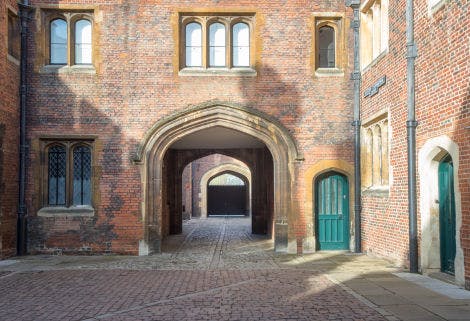
Image: Seymour Gate at Hampton Court Palace, looking west from Master Carpenter's Court. © Historic Royal Palaces
Raw materials
Raw produce was brought into the palace through a ‘Tradesman’s’ entrance.
All goods passed under an archway into a cobbled courtyard, where they were all unloaded and checked scrupulously.
A team of accountants, known as ‘The Clerks of the Green Cloth’, kept meticulous records to ensure costs were kept under control.
Kitchen staff carried the goods into a series of smaller kitchens or to the stores.
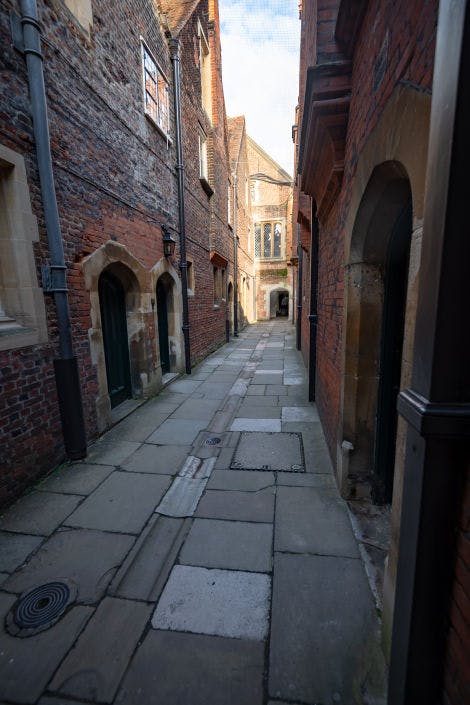
Image: Fish Court at Hampton Court Palace. © Historic Royal Palaces
From kitchen to table
Preparing and storing food for the Tudor court
The kitchens at the Tudor court produced a large amount of food and each room had a specific function. Food would be taken from larders and prepared in separate bake-houses. Meat was roasted in front of the big fires in the Great Kitchen.
Fresh water for drinking and cooking was piped into the palace from springs three miles away.
The Boiling House
The Boiling House was one of the many smaller kitchens in Henry's complex. It was used exclusively to prepare and cook meat in the great boiling pot.
The meat then went into pies or was roasted, the boiling being used to reduce the time needed on the spit. The pie cases were brought over to the boiling house from the pastry department.
From the Boiling House, courtiers and servants traversed the surrounding cloisters to take their food into the Great Hall or Watching Chamber.
Fish Court
Fish Court is a clever fridge system. The courtyard is narrow, running north to south which means the area stays cooler, as the sun does not shine directly in. The space is open to the air to keep the stone stores cool.
Each side of the courtyard is lined with doors to storerooms and smaller kitchens called Working Houses, where more complex dishes were made.
The Serving Place
Once the food left the kitchens, it was transferred to the Serving Place, where dishes were collected and prepared for presentation. Nearby, the Wine Cellar stored the finest wines from across Europe, ready to be enjoyed by the court alongside their meal.
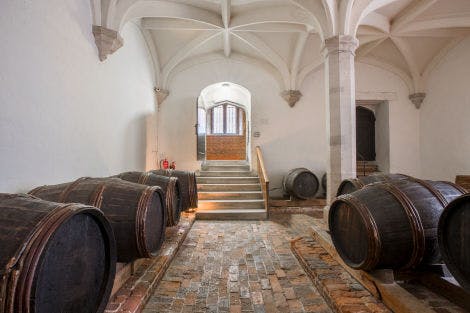
Image: The wine cellar. © Historic Royal Palaces
Henry VIII's wine cellar
All of this food was washed down at court with gallons of wine and beer.
Entertaining the court in lavish style reflected the magnificence of the monarch and Henry kept his cellars well stocked.
Barrels of wine were sent from Europe and kept in cellars next to the kitchens, while beer was stored close to the Great Hall.
Did the Tudors drink water?
A common misconception is that nobody in Tudor England drank fresh water, and that ale was the drink of choice for all. In reality, the Tudors did drink water and it was safe to consume at the palace.
Unlike wine, ale and beer, which cost money to produce and transport, water left little trace in the historical record because it was free. It was also commonly mixed with wine or beer to adjust both flavour and strength.
Watch: Baking Tudor pastries
The origin story of the 'Maids of Honour Tarts' is somewhat controversial.
According to one story, Henry VIII liked them so much that he had the recipe locked in an iron box, only to be produced for the royal family.
In fact, curd tarts date back to the medieval period. With lemon curd, brandy and spices, will our tasters think Marc’s tarts are as good as Henry VIII supposedly did?
Watch on YouTubeThis content is hosted on YouTube
This content may be using cookies and other technologies for which we need your consent before loading. To view the content, you need to enable cookies for "Targeting Cookies & Other Technologies".
Video transcript
Watch a transcript of this video on YouTube. A link to the transcript can be found in the description.
Explore Henry VIII's Kitchens at Hampton Court
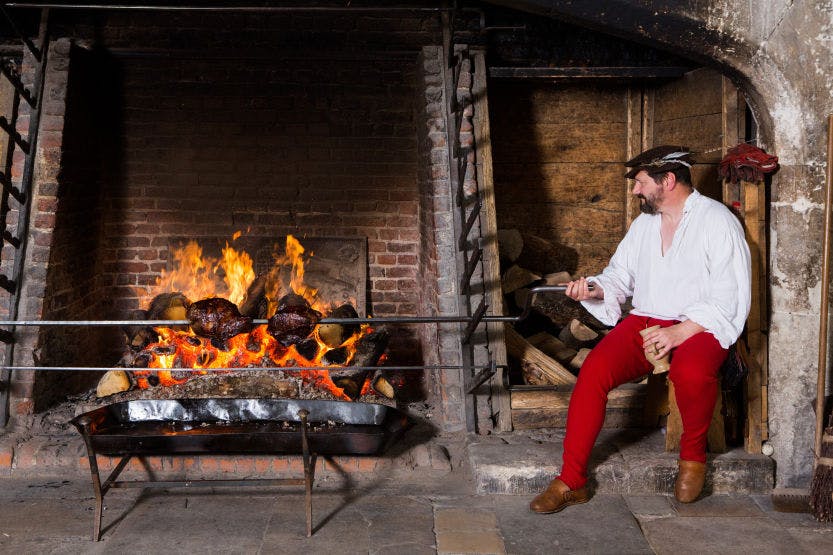
Virtual Tour: Henry VIII's Royal Kitchens
Discover more about Henry VIII's Royal Kitchens with our interactive story, created in partnership with Google Arts & Culture.
Browse more history and stories

Thomas Wolsey
Henry VIII’s right-hand man – until the King met Anne Boleyn
Elizabeth I
From Tower prisoner to English Queen
The story of Hampton Court Palace
Home of Henry VIII and the Tudor dynasty
Explore what's on

- Events
- Christmas
Hampton Court Palace Festive Fayre
Discover a winter wonderland with over 100 artisan producers at Henry VIII's palace.
-
Dates:
04 - 06 and 11 - 13 December 2026
- Times: 10:00 - 17:00. Palace closes at 16:30 (except 11 December)
- Location: Hampton Court Palace
- Ticket type: Included in palace admission. (Members go free, pre-booking required)

- Things to see
The Tudor World in the Wolsey Rooms
Discover the oldest rooms at Hampton Court Palace and meet the ordinary men and women who enabled the Tudor court to exist and flourish.
-
Dates:
Open
- Times: In line with palace opening hours
- Location: Hampton Court Palace
- Ticket type: Included in palace admission (Members go free)

- Things to see
Georgian Story
Discover the grandeur of the Georgian royal court and follow in the footsteps of queens and kings in the rooms where they lived and entertained guests.
-
Dates:
Open
- Location: Hampton Court Palace
- Ticket type: Included in palace admission (Members go free)
Shop online
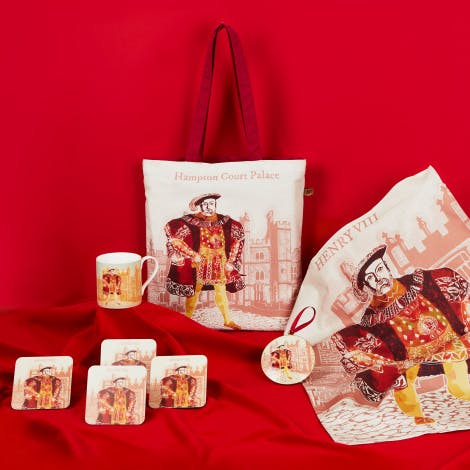
Shop Tudors
Find the perfect gift for collectors and history enthusiasts in our treasure trove of souvenirs inspired by this ever-fascinating dynasty.
From £3.00

Shop Goblets & Tankards
Discover our decadent range of goblets and tankards inspired by the palaces in our care, the perfect gift for any history fan.
From £10.00
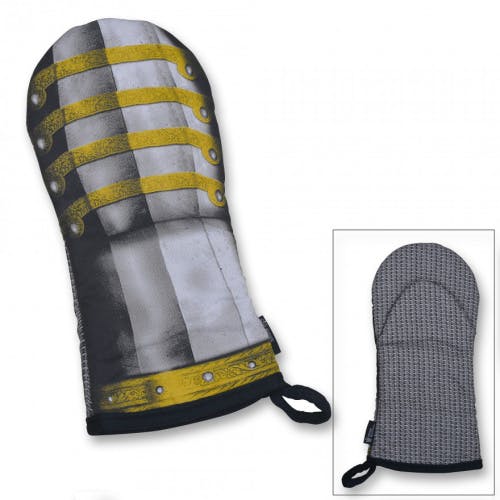
Henry VIII Gauntlet Armour Oven Glove
This fun oven glove is inspired by a suit of armour made for Henry VIII in 1540, currently on display at the Tower of London.
£18.00