
Christmas in the Tudor royal court
How did monarchs such as Henry VIII and Elizabeth I celebrate Christmas?
Date: 22 December 2025
Author:
Tracy BormanThe Tudors loved a good party. Life in the royal court during the Tudor period was one long round of feasting, entertainments and revelry. But then, as now, the greatest spectacle was reserved for a Tudor Christmas.
Here, Tracy Borman heads back to the courts of Henry VIII and Elizabeth I for a Christmas like no other.
We tend to think that our modern Christmas derives largely from the Victorians, but many of our traditions date back to Tudor times and earlier. Singing carols, kissing under the mistletoe and eating turkey with stuffing, Christmas pudding, mince pies and even Brussels sprouts were all part of a 16th-century Christmas.
But while the focus of a modern-day Christmas is 25 December, the Tudors celebrated all 12 days of the festive season with almost equal revelry and excess.

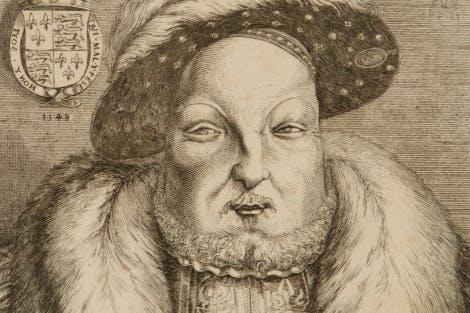
Image: Henry VIII always made sure he was the star of the show at Christmas, dressing himself in sumptuous new clothes every year. Henry VIII in around 1538-47, after Hans Holbein the Younger. © Royal Collection Enterprises Ltd 2025 | Royal Collection Trust

Image: The Great Hall at Hampton Court Palace, decorated for Christmas. © SWNS / Historic Royal Palaces
Christmas, Tudor-style
By Tudor times, Christmas had become the most highly-anticipated festival in the court calendar. Preparations for the yuletide season often began weeks in advance.
The Church encouraged people to fast during Advent (the period just before Christmas). This meant that by the time 25 December arrived, everyone was even more eager to begin the feasting and revelry.
Even those who were not fortunate enough to be at court enjoyed a rare holiday from the daily toil and a richer than usual diet. This might include pork and whatever birds they could catch, as well as honey to sweeten dishes and fresh seasonal berries.

Image: Henry VIII was praised for celebrating Christmas in style, traditionally at Greenwich Palace. Henry VIII in around 1530-35, by Joos van Cleve. © Royal Collection Enterprises Ltd 2025 | Royal Collection Trust
Henry VIII was praised for keeping Christmas with ‘much nobleness and open court’, along with ‘great plenty of viands’. Greenwich Palace (the place of his birth in 1491) was the traditional location for the yuletide festivities. More than a thousand courtiers would flock there to eat, drink and be merry – and warm themselves by the huge yule log that was lit on Christmas Eve.
Twelve days of festivities would follow – all of equal excess and magnificence, with games, carols and even an appearance by Father (or ‘Captain’) Christmas.
But the star of the show was always Henry, decked out in sumptuous new clothes every year. And he didn’t stint on the expense. The records show that for the first Christmas of his reign in 1509, the 18-year-old King laid out the equivalent of £13.5 million.
‘Oh bring us a figgy pudding’ (and boar, lark, quail and goose…)
Spare a thought for the Tudor royal cooks, who were obliged to prepare not just one Christmas dinner, but a whole host of sumptuous feasts on each of the 12 days.
After an appetiser of plum porridge or figgy pudding, a boar’s head would be carried in smeared with mustard and with a roasted apple in its mouth.
Next came a variety of rich meats, including larks, quails, capons, soused veal and – the favourite for all classes – brawn, which comprised fatty cuts of richly spiced boar meat or pork. Turkey also made an appearance in the later Tudor period, but the most popular Christmas bird was goose.

Image: Royal cooks were responsible for feeding hundreds of people a day. At Hampton Court, the King's meals were served from Henry VIII's Kitchens, which are still in use today. © Historic Royal Palaces / SWNS

Image: The Tudor royal court enjoyed sugar sculptures (known as 'subtleties') which were presented in a variety of shapes and sizes. These could then be painted, like this. © Historic Royal Palaces
For dessert, there was Christmas pudding (similar to suet pudding) or ‘frumenty’, made with eggs, fruit, spices, almond milk and cream. Also popular were jellies moulded into castles or animals, or spectacular sugar sculptures, sometimes carved into suggestive shapes to excite lust!
Mince pies were also served, but were savoury rather than sweet and contained shredded leftover meats. All of this was washed down with French wine or specially brewed Christmas ale.
A new king at court… the ‘Lord of Misrule’
The Master of Revels devised a whole series of entertainments for each of the 12 days, including masques, plays, music, disguisings, jousts and hunting. Board games ranged from chess and backgammon to guessing games, hide and seek, and blind man’s buff. Dice and cards were also popular.
All of this revelry was presided over not by the King, but the ‘Lord of Misrule’. Even Henry had to bow to his authority. In the first year of his reign, the role was filled by Will Wynesbury, who cheekily asked the King for £5 towards his expenses. Fortunately, his royal master appreciated the joke.
Even though the court was full to bursting, the public were often allowed in to watch the ‘goodly and gorgeous’ displays.
Towards the end of his reign, Henry VIII passed a law that all craftsmen, labourers, mariners, fishermen, servants and apprentices could only play cards, dice, football, bowls, tennis, ninepins and other popular games at Christmas. They were to abstain from any other sport or activity except archery during the rest of the year to maintain England’s military strength.
Watch: what board games did Henry VIII play?
In this video, historians Tracy Borman and Charles Farris discuss all the different games played by the Tudors, and even have a go themselves.
Learn about the types of games played in the 16th century, the first lottery in England, and how to play Fox and Geese, a popular board game from the 16th century.
This content is hosted on YouTube
This content may be using cookies and other technologies for which we need your consent before loading. To view the content, you need to enable cookies for "Targeting Cookies & Other Technologies".
What did people in the Tudor period do for fun? In the 1500s, all classes of people played board and card games to keep themselves entertained, including Henry VIII, his wives, and their courtiers. In this video, historians Tracy Borman and Charles Farris discuss all the different games played by the Tudors, and even have a go themselves. Learn about the types of games played in the 16th Century, the first lottery in England, and how to play Fox and Geese, a popular board game from the 16th century.
Video transcript
Watch an interactive transcript of this video on YouTube. The link to the transcript is in the description.

Image: Henry VIII received this portrait of his son Prince Edward on New Year's Day 1539. Public domain
What do you get the king who has everything?
Festive royal gifting in the Tudor period
Gifts were exchanged on New Year’s Day. Henry VIII encouraged his courtiers to come bearing lavish gifts, which would be given to him during a special ceremony in his presence chamber. His nobles would vie with each other to give the most valuable or admired present. Cardinal Thomas Wolsey once gave his master a gold cup worth £100 (more than £50,000 in today’s money).
Some of the more unusual gifts that Henry received included dog collars, six cheeses from Suffolk and a marmoset monkey. His most treasured present, though, was Hans Holbein’s exquisite portrait of the King’s ‘precious jewel’ (his son Edward – the future Edward VI), which was given to him on New Year’s Day 1539.

Image: Elizabeth I after the portrait by Marcus Gheeraerts the Younger (1561 or 1562-1636) © Historic Royal Palaces
Gift giving scaled new heights during the reign of Henry’s youngest daughter, Elizabeth I, who regularly received thousands of lavish gifts each year – everything from jewellery to toothpicks made of gold!
But the true message of Christmas was never lost. All of the Tudor monarchs prided themselves on being devout and pious. Elizabeth I paid particular attention to the religious aspects of the festival and would spend most of Christmas Day in prayer. Their courtiers were also required to attend a series of solemn ceremonies, and throughout Tudor England everyone went to church on Christmas morning.
All's well that ends well
All good things must come to an end, but the Tudors made sure that Christmas went out with a bang. On 6 January they celebrated Epiphany with a day of processions, feasts and fun. Spicy foods (representing the Wise Men) were served as part of the menu and the yule log was kept burning until midnight.
Every year at Hampton Court Palace, the spirit of a Tudor Christmas returns to the palace. Henry VIII’s Kitchens are alive with the sounds and smells of Christmas once again, and music fills the halls. Christmas services in the Chapel Royal continue under Henry VIII’s beautiful vaulted ceiling. So now everyone can enjoy a Hampton Court Christmas, without feeling obliged to compliment Henry on his festive new clothes!
Tracy Borman
Chief Historian, Historic Royal Palaces
Listen to the podcast
What did the Tudors eat for Christmas?
What was on the table for a Tudor Christmas dinner? From the lavish feasts of Henry VIII to the sugar delicacies gifted to Elizabeth I, Christmas at court was a spectacle to behold and to taste. But for ordinary people, the preservation of meats, cheese, fruit and vegetables was essential to even last the winter.
In this episode of the Historic Royal Palaces podcast, Hampton Court Palace’s Historic Kitchens Team discuss the culture and festivities of the Christmas period in 16th-century England.
More episodesEnjoy Christmas at our palaces

Christmas at Hampton Court Palace
Until 04 January 2026 (Excluding 24-26 December)
Step into the Christmas spirit at Hampton Court Palace. Enjoy delicious treats and artisan gifts in the palace gardens with the Festive Fayre, have fun skating at the Ice Rink, let imaginations run wild in the Magic Garden and get into the festive spirit with seasonal tunes in the palace.

Christmas at the Tower of London
Until 04 January 2026 (excluding 24-26 December & 01 January)
Celebrate Christmas at the Tower of London with storybook-themed displays, sparkling decorations and festive tales from its rich history.
More from our blog
The Weird and Wonderful Medicines of Henry VIII
12 January 2023
Henry VIII is one of England’s most famous monarchs, but lesser known are his numerous medical problems and the often-extraordinary remedies which he used to treat them.

Edward I’s Santa Suit: Christmas in the Medieval Palace
10 December 2021
Curator Charles Farris explores how Edward I and his royal medieval court celebrated Christmas.

A Christmas Pudding Recipe with a Victorian twist
06 December 2023
Richard Fitch, Historic Kitchens Manager at Historic Royal Palaces, reimagines a Victorian recipe that you can make at home just before Christmas day.