You are at the top of the page

Skip to content or footer

Start of main content

The Royal Household in the Medieval Period

Living and working in the Medieval Palace

The Tower of London has served as a royal palace since shortly after its creation, alongside its many other royal functions.

In the 1200s, King Henry III and his son Edward I spent a fortune expanding and developing the Tower of London including developing lavish new riverside apartments. The Medieval Palace provided kings and queens with space to work, sleep, pray, entertain, and conduct business.

The royal households in the medieval period 

Life in the Medieval Palace was only possible because of the hundreds of servants that made up the royal households. These people attended to the everyday needs of the royal family, provided the core of the royal army, and helped govern the country. The king and queen employed dozens of messengers to take their orders around the country.

Image: Recreation of a stonemasons table. Robert of Beverely was the master mason who oversaw Edward I’s works at the Tower. He was one of the great architects of his age. © Historic Royal Palaces

Managing the finances

The royal clerks 

Clerks were an essential part of the royal household machine. They were trained in the Church, great with numbers, and often skilled writers. These expert administrators ran the household departments, wrote letters, and kept track of royal spending.

The documents these clerks created survive in large numbers. It’s thanks largely to these documents that we know about medieval royal life today.

Did you know?

Edward I had a household of over 500 people, and Queen Eleanor of Provence more than 150.

Clothing the household

The Great Wardrobe 

The Great Wardrobe bought cloth and other precious goods. Everyone in the royal households received new robes twice a year in addition to their wages. Clothing was an indicator of status: the higher up you rose in the household, the more expensive your robes. The finest cloths and furs were usually reserved for the king and queen.

Acquiring goods was a challenge and the Great Wardrobe’s staff frequently travelled to fairs and markets. They also employed tailors to make clothing for the king, furnishings for domestic spaces, vestments for use in royal chapels, and even flags and banners. Storing so many bulky goods was tricky and the Great Wardrobe had a permanent store at the Tower of London. 

Did you know?

Many goods were bought at fairs including St. Botulph's in Boston (Lincolnshire), St. Giles' in Winchester (Hampshire), St. Edward's in Westminster (Middlesex), and St Ives' (Cambridgeshire).

Stone remains of a old tower made of light brown stone. Benches and decorative fencing and a signpost are in front of the stone remains and a large light stone building is in the background.

Image: The ruined Wardrobe Tower may have been the site the medieval Great Wardrobe store. © Historic Royal Palaces

St Thomas's Tower. Reconstruction of the king's bedchamber in the medieval palace as it might have appeared during the reign of King Edward I (1272-1307).

Image: Recreation of a medieval bedchamber. © Historic Royal Palaces

Decoration and display

Medieval Palaces were richly decorated with colourful wall paintings, rich wall hangings, and expensive furniture. In 1238, for example, Eleanor of Provence’s chamber at the Tower was painted with false pointing (that looked like masonry) and flowers.

Just two years later it was redecorated with roses. Decoration wasn’t just for comfort; these lavishly adorned spaces provided an important projection of royal power.

Queen Eleanor of Castile was particularly influential in the decoration of English Royal Interiors. In 1255, when Eleanor first arrived in England after marrying the future Edward I, chronicler Matthew Paris commented the English were suspicious of the ‘Spanish style’ of hanging interiors with fine fabrics.

A household on the move

Royal travel

The royal household was rarely in one location for very long. Kings had to keep moving to visit their diverse lands, distribute justice, hear complaints, and keep an eye on unruly subjects. Travel was slow, and the royal household could move just 15 miles each day. 

Moving the people and equipment required for medieval royal life was a major challenge. Much of the furniture was cleverly designed so it could be dismantled and transported.

By the end of Edward I’s reign, his household required six long carts, seven short carts, and 41 packhorses to transport all the furniture, equipment and supplies needed for his household.

Did you know?

Edward I, despite spending a fortune on building works at the Tower, spent just 53 days there during his 25 years reign.

A woman washing her laundry in a stream.

Image: A woman doing laundry in the Codices Palatini germanici. Courtesy of Heidelberg University Library (Public domain) 

Majestic materials

Clothing and laundry in the medieval royal court

Fashion was an important part of medieval royal life; the king and queen’s clothing, and that of their household staff, projected their royal power and authority.

Clothing had to be carefully washed to maintain its appearance – especially tricky because natural dyes would fade more quickly over time. This skilled work was usually done by laundresses.

Although primarily a female profession, some men did do this work – some even claiming it was inappropriate for women to wash linen used in religious ceremonies.

View of King Edward I's four poster bed with bright red curtains surrounded by lavish wall hangings and next to a richly decorated fireplace.

Image:Edward I’s recreated bed at the Tower. In 1280, Edward I ordered a new bed for 11 shillings and penny. © Historic Royal Palaces

Edward I employed two laundresses. One was responsible for the napery, which predominantly included table linen, the other responsible for the king’s clothing.

Edward I’s long-serving laundress was called Matilda de Wautham, who was responsible for washing the king’s robes. Although laundresses were generally of low status, Matilda’s wages and robes allowance show that she held an important role within the household. When Matilda retired, Edward I organised a pension for the remainder of her life.

Food and feasting

Feeding the royal court in the medieval period

The royal household consumed great quantities of food prepared in departments including the kitchens, pantry (which provided bread), saucery (which provided sauces), and buttlery (which provided wine).

The king and queen usually ate in the privacy of their chambers, but on special occasions ate with the rest of their household and guests in the great hall. 

On special occasions, the great hall was the setting for huge feasts requiring vast quantities of food. On Christmas Day 1286 the King's household consumed 13 tuns of wine – over 3,000 gallons! The Christmas day menu of 1304 included 1,742 chickens, 204 partridge, and 192 ducks. 

Royal food was flavoured with spices from all over the world, including ginger, mace and saffron – purchased by the Great Wardrobe. Records show that Queen Eleanor seems to have missed food from her Spanish homeland. In 1289, she purchased lemons, oranges, pomegranates, and figs from a Spanish ship. 

Tap or click on a hotspot to explore

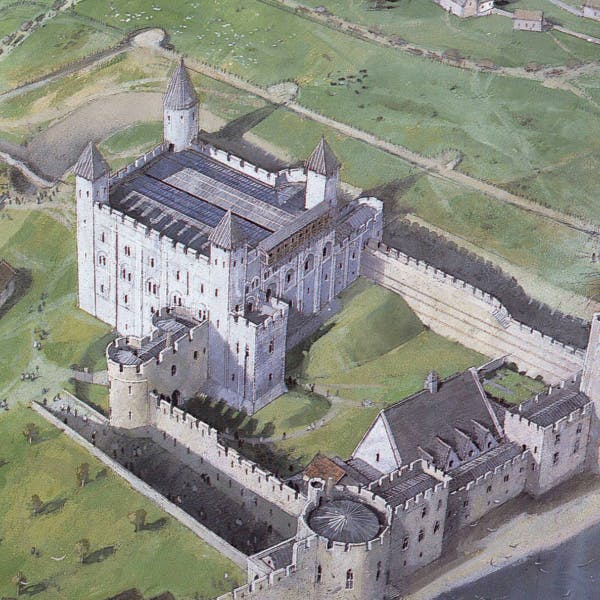
Reconstructed view of the Tower of London from the south west in about 1320.

Where was the Great Hall located?

Detail of an illustration showing a white gable building.

The Great Hall's location

At the Tower the medieval Great Hall was to the south of the White Tower, roughly halfway between the Wakefield and Lanthorn Towers. 

Image: Reconstructed view of the Tower of London from the south west in about 1320. © Historic Royal Palaces

The royal nurseries

Childhood and education 

Royal children had their own households from a young age and did not usually travel with their parents until they were older. While this seems strange to us today, medieval childhood was dangerous, and this precaution would have been for their own safety. In the 1200s several palaces acted as royal nurseries including Windsor, Langley, Woodstock.

Royal children were educated for later duties and responsibilities. Although Anglo-Norman (a type of French) was the main language of the court, they would have been taught some Latin, and in likelihood some English too. Royal children were often taught by members of the church, particularly Dominican friars in the 1200s. 

Royal children would have been taught to ride and hunt from a young age, learning essential skills for the battlefield. Play was also important and helped develop skills for the future.

Edward I and Eleanor of Castile provided their children a toy castle, and siege engines – perhaps hoping Prince Edward would one day be a great warrior. They also had a little cart, perhaps for pulling each other along.

Did you know?

Queen Eleanor of Castile was particularly learned and employed two scribes and a painter to copy books for her library.

A photograph featuring the painted timber screen and stained-glass window of The King's Private Chapel at The Wakefield Tower Throne Room at the Tower of London.

Image: In 1238, a screen was added between Henry III’s chapel and chamber – like the recreated screen in the Wakefield Tower. © Historic Royal Palaces

How did medieval kings practice religion?

Religion was an essential part of royal life. Kings like Henry III and Edward I employed large teams of chaplains who helped organise their religious activities. They heard Mass every day, richly decorated their private chapels, and often visited nearby churches on their travels.

Charity was important and royal almoners fed hundreds of poor people each day, and distributed leftover food and old clothing to the needy.

Saints were an important part of royal religion. King Henry III was particularly dedicated to Saint Edward the Confessor and spent a fortune rebuilding Westminster Abbey in his honour.

Medieval kings often had large collections of relics (fragments of saint’s and objects associated with them) which they travelled with and used in daily devotions. Edward I’s most prized relic was the Cross of Gneth which he took from the Princes of Wales in 1283. 

A perfectly preserved wicker fish trap excavated from the Tower moat.

Image: Fish trap excavated from the moat at the Tower of London. The royal household consumed huge quantities of fish, particularly during religious fasts when meat was forbidden. © Historic Royal Palaces

Bone tablemen and ivory dice, 1200s

Image: English Bone tablemen and ivory dice, 1200s, on display in The Medieval Palace. These counters and dice were perhaps used to play ‘tables’ – a popular board game which developed into backgammon. © London Museum

Entertainment and games

Entertainments were an important part of medieval court life. Hunting and hawking was particularly important among the elite – and birds of prey were often sent as diplomatic gifts. Edward I once sent a wax image of a sick falcon to the shrine of St Thomas of Canterbury, hoping for a cure. Music was also very popular and minstrels often accompanied great feasts.

Games were also very popular particularly among the elite, including dice and chess. Edward I once gave Eleanor of Castile a chess set made of crystal and ivory.

Gambling often accompanied these games, and royal debts sometimes appear in royal household accounts. Edward I once lost a warhorse in a bet with his laundress Matilda de Wautham, and had to buy it back from her.

Working up the career ladder in the royal household

Life in the Medieval Palace was exhausting, but it provided great opportunities for those who were hardworking and capable.

For example, Walter Langton began as a humble household clerk in 1281 but by 1290 was Keeper of the Wardrobe – the most senior household clerk. In 1295 he was made Treasurer of the Exchequer, and in 1296, bishop of Coventry and Lichfield.

Langton was a controversial figure who made many enemies but is a fascinating example of the opportunities the royal household could provide.

Watch: medieval employment | The best & worst Jobs at the Tower in the 1200s

Life in the medieval palace was only possible because of hundreds of servants who lived with king and queen, and followed the court wherever it went. But what was life like inside the medieval palace? 

Curator Charles Farris takes a look inside the palace and objects from its past in this video.

Watch on YouTube

This content is hosted on YouTube

This content may be using cookies and other technologies for which we need your consent before loading. To view the content, you need to enable cookies for "Targeting Cookies & Other Technologies".

Manage Cookies

The Tower of London underwent significant change during the 1200s under the medieval kings, Henry III and Edward I. But the Tower wasn’t just home to knights and royals. Life in the medieval palace was only possible because of hundreds of servants who lived with king and queen, and followed the court wherever it went. But what was life like inside the medieval palace? Today we take a closer look inside the palace and objects from its past, to tell us what life could have been like working within the palace itself.

Video transcript

Follow along with an interactive transcript of this video on YouTube. A link to open the transcript can be found in the description.

Browse more history and stories

Eleanor of Provence

A powerful and political Queen

William the Conqueror

England's first Norman King

Jewish Medieval History at the Tower of London

The Tower of London holds a principal place in the complex story of England's Medieval Jewish community.

Explore what's on

BOOKING SOON

  • For members
  • Events

Members-only Ceremony of the Keys

Members-only access to the traditional locking up of the Tower of London, the Ceremony of the Keys.

  • 22 March, 26 April, 17 May 2026

  • 21:30
  • Tower of London
  • Separate ticket (advance booking required)
Learn more
  • Things to see

Gun salute

See special commemorative firings at the Tower of London on the Gun Park located on the Wharf.

  • Selected dates
  • Tower of London
  • Free
Learn more
  • Tours and talks
  • Things to see

Yeoman Warder tours

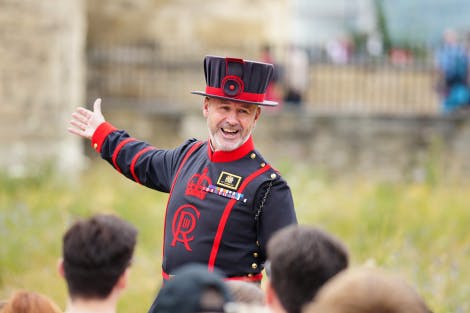
Tour the Tower of London with a famous Yeoman Warder during your visit. Be entertained by tales of intrigue, imprisonment, execution, torture and much more...

  • Daily

  • Tours begin every 45 minutes
  • Tower of London
  • Included in palace admission (Members go free)
Learn more

Shop online

Shop Medieval

Step back in time with our medieval inspiration collection, full of fascinating ornaments and homewares for your collection.

From £3.50

Shop Kings & Queens of England

Discover our informative and best selling range, inspired by the incredible history of the Kings and Queens of England.

From £4.99

Tower of London Navy Raven Sweatshirt

Inspired by the infamous ravens of the Tower of London, this sweatshirt will keep you warm on those chilly days.

£38.00