

Discover Hillsborough Castle's historic American connections
Skip the event ticket details and go to event summary.
When
Open
Ticketing information
Included in combined castle tour and gardens tickets (Members go free)
Buy Hillsborough Castle and Gardens ticketsThe magnificent State Dining Room has become The Benjamin Franklin Dining Room this year to highlight the 250th anniversary of the US Declaration of Independence. A very special collection of objects relating to the renowned statesman are on display to mark the occasion.
American Founding Father, Benjamin Franklin visited Hillsborough Castle in 1771 to discuss American colonial matters with Lord Hillsborough, Secretary of State for the Colonies at the time. He would have dined in this room during his stay.
Seven remarkable objects tell the story of Franklin and Hillsborough's turbulent relationship and events leading up to the American War of Independence.

He seem’d attentive to every thing that might make my Stay in his House agreeable to me...covering me with his own Great Coat, lest I should take Cold.
Benjamin Franklin, describing the warm welcome he received at Hillsborough Castle
The birthplace of America?
At the time of Franklin’s visit, the famous diplomat had become the most prominent spokesman for the American colonies. Meanwhile Lord Hillsborough took a hardline approach as Secretary of State and Franklin frequently criticised his harsh actions and policy decisions.
It was a surprise to Franklin, therefore, when Lord Hillsborough invited him to stay and treated him so cordially. It is thought Lord Hillsborough hoped to repair his bad reputation in the colonies by making a good impression.
However, after the visit, normal hostilities resumed, prompting some to refer to Hillsborough Castle, tongue in cheek, as the ‘birthplace of America’ – as it was a missed opportunity for the American Secretary to show more understanding of the frustrations of the American colonists.
Objects on display
On display for a limited time, don’t miss your chance to see this fascinating collection.

On loan from American Philosophical Society. Gift at the bequest of Lamont duPont Copeland, 1983.
Portrait of Benjamin Franklin
By Jean-Baptiste Greuze
Oil on canvas, 1777
Admire one of the most recognisable portraits of Franklin up close. Painted six years after his visit to Hillsborough Castle, Franklin was 71 years old and had just moved to Paris to become ambassador to France.
Eminent French artist Jean-Baptiste Greuze was commissioned by Abbé Joseph Alphonse de Véri, a friend of Franklin and collector of Greuze's works.
...depicting there all the nobility of a free spirit, all the wisdom of an orderly mind and all of a statesman's sagacity.
Abbé Joseph Alphonse de Véri in praise of Greuze's portrait of Franklin
Portrait medallion of Wills Hill, Lord Hillsborough
c.1790
Commissioned many years after the Franklin visit and the dawn of American independence, this exquisite Wedgewood portrait is in the ceramicist's signature shade 'Wedgewood blue'.
Extremely popular in the 18th century, Wedgewood portrait medallions were made from jasperware, a ceramic material invented by Josiah Wedgewood.

Gifted to Historic Royal Palaces by the trustees of the Sandys Trust (Registered Charity Number 1168357)
Benjamin Franklin’s chess pieces
c.1750-80
A huge advocate for chess, Franklin believed players gained all kinds of life lessons from the game. His essay ‘The Morals of Chess’ is still popular with players today.
These thirty-two chess pieces, made from turned fruitwood were surely treasured by Franklin and helped train his strategic mind.
Look out for the knight pieces, carved on two sides to form a point, instead of a horse's head, suggesting this is probably a French chess set.

On loan from American Philosophical Society. Gift of Morris Duane, 1976.
For life is a kind of chess
Benjamin Franklin
Publication of the Declaration of Independence
Printed by Hugh Gaine, New York, 4 July 1776
A highlight of the collection, this copy of the US Declaration of Independence was one of the first to cross the Atlantic.
It was printed by Hugh Gaine, who was born in Belfast around 1726 and emigrated to New York, where he became a successful printer and publisher. This copy was sent by the governor of New York, William Tyron on 14 August 1776 addressed to the Secretary of State for the Colonies (no longer Wills Hill by this stage).
On loan from The National Archives for a limited period until June 2026.
Letters on display
All on loan from the Benjamin Franklin Papers, American Philosophical Society.
Note from Richard Henry Lee
1828
This note provides important context for the next letter in this display. Richard Henry Lee states that the letter is ‘in the handwriting of Dr. Franklin’ and that it contains ‘a singular and amusing conversation between Dr. Franklin and Lord Hillsborough’.
A written account by Benjamin Franklin
16 January 1771
Benjamin Franklin describes the heated exchange with Lord Hillsborough at his house in London. Franklin had been appointed as agent for the colony of Massachusetts, which Lord Hillsborough angrily rejected. The two men parted on bad terms.

Tap to zoom

Click to zoom
Letter from Benjamin Franklin to Thomas Cushing
13 January 1772
Franklin writes to his friend about his visit to Hillsborough Castle and his surprise at the warm welcome he received. Lord Hillsborough’s seeming change of heart in American matters was particularly puzzling. However, when the two men returned to London, Lord Hillsborough resumed his stubborn attitude towards the colonies and their relationship deteriorated.
On loan from the Benjamin Franklin Papers, American Philosophical Society.
History of the State Dining Room
The State Dining Room has been in constant use since the house was built. The doors to the kitchens and ancillary areas are shielded by leather screens so that servants could enter and leave discreetly.
During state dinners, the host is expected to sit at the centre of the dining table with their back to the fireplace. Queen Elizabeth II continued this tradition during her first visit as Queen during her Coronation Tour in 1953.
From her seat at the table, the Queen had a direct view to the Granville Garden, which was created by her aunt Rose, the Countess of Granville.

Other artwork on display

Image: Portrait of Lord Marcus Hill by Thomas Lawrence. Gifted to Historic Royal Palaces by the trustees of the Sandys Trust (Registered Charity Number 1168357).
This painting depicts Marcus Hill, son of Arthur, 2nd Marquess of Downshire and his wife Mary, née Sandys. It was painted by leading portrait artist Thomas Lawrence and is the only painting of Marcus Hill on display at Hillsborough Castle.
The portrait was commissioned by his mother and shows Marcus at 18 years old, before he left for Madrid as secretary to the British envoy to Spain. Lawrence’s portrait joins the ranks of other court artists whose work is on display in the castle, including Anthony van Dyck, Joshua Reynolds and Peter Lely.
This portrait was gifted to Historic Royal Palaces by the trustees of the Sandys Trust (Registered Charity Number 1168357).
The painting on the far side of the State Dining Room depicts the impressive figure of Lord Arthur Hill, second son of the second Marquess of Downshire.
Lord Arthur fought in the Peninsula War before becoming a captain and 'Aide de Camp' to Arthur Wellesley, 1st Duke of Wellington, to whom he was related.
In June 1815, Lord Arthur travelled to Dover on horseback and commandeered a boat for £22 to row across the Channel and join the imminent conflict at Waterloo. Wellington famously said that 'if there hadn’t been a boat, Arthur would no doubt have swum'.
George III and Queen Charlotte met in the afternoon of 8 September 1761 and were married that evening. George was the first Hanoverian King to be born and raised in England.
Despite being one of the longest-reigning monarchs in British history, George is often remembered for his frequent bouts of mental illness.
The portraits of the King and Queen in the State Dining Room are part of a series of copies by Scottish artist Allan Ramsay and his studio.

This exhibition forms part of the wider USA–NI250 commemorations and was part funded by the Department for Communities Northern Ireland.
Explore what's on

- Things to see
- Tours and talks
The Castle
Discover elegant State Rooms still used by the royal family inside Hillsborough Castle.
-
Dates:
Open
- Location: Hillsborough Castle
- Ticket type: Included in combined castle tour and gardens tickets (Members go free)

- Things to see
State Entrance Hall
Start your tour in the magnificent state entrance, where royals, politicians and peacemakers all enter the castle.
-
Dates:
Open
- Location: Hillsborough Castle
- Ticket type: Included in combined castle tour and gardens tickets (Members go free)

- Things to see
State Drawing Room
Discover contemporary Irish art from the collection of His Majesty The King in this elegant family space.
-
Dates:
Open
- Location: Hillsborough Castle
- Ticket type: Included in combined castle tour and gardens tickets (Members go free)
Browse more history and stories
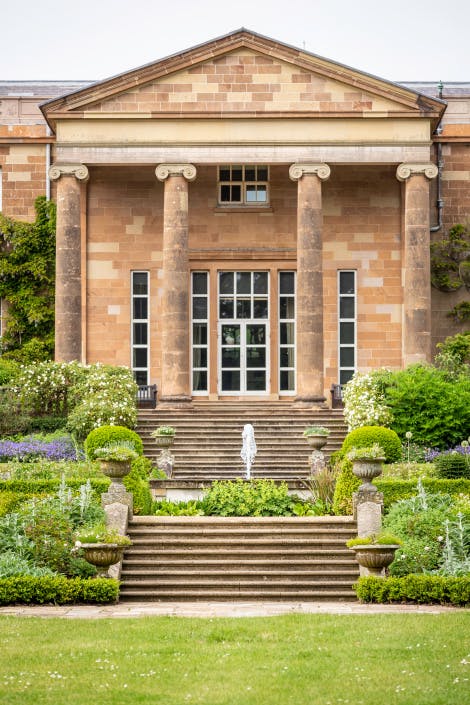
The story of Hillsborough Castle and Gardens
‘The Grandest House in County Down’

Art at Hillsborough Castle
Hillsborough Castle has become a place in which to see amazing art

Good Friday Agreement
Hillsborough Castle was the scene for key meetings that led to this historic moment in Northern Ireland’s history
Shop online

Shop Homewares
Explore our collection of stylish home accessories and furnishings, including cushions, tapestries, glassware and much more.
From £3.50

Shop Jewellery
Discover our timeless jewellery collection, each piece inspired by the beauty and history of the palaces in our care.
From £2.50

Royal Palace Fine Bone China Collection
Exclusive to Historic Royal Palaces, this exquisite fine bone china collection is inspired by the beautiful palaces in our care.
From £28